120th Anniversary of the Constitutional Decree Message, August 5, 2026
My fellow compatriots,
Today, the anniversary of the signing of the Constitutional Decree on 14 Amordad 1285 (August 5, 1906), reminds us of one of the greatest movements in Iran's modern history — a movement that arose from the thought and decades-long effort of patriots who suffered from Iran's backwardness and disarray under Qajar rule.
The ideal of constitutionalism rested on three fundamental principles:
the rule of law;
national sovereignty and the will of the nation;
and the progress and advancement of Iran.
The constitutionalists understood well that without law, a modern judiciary, and sound economic order, the country's independence and progress would not be possible. Perhaps the words of Abolhassan Khan Pirnia, the representative of Tehran at the session of 15 Shahrivar 1286 of the first National Consultative Assembly, best capture and embody what they sought:
"The people of Iran have reached the end of their endurance; we need two things — one is finance, and the other is justice."
The book "One Word" by Mirza Yusef Khan Mostashar od-Dowleh recalled this same truth: the secret of a country's progress can be summed up in a single word — law.
But this struggle met the resistance of those who championed religious rule, who placed the authority of sharia and the clerics above the law and national sovereignty. That current of thought came, decades later, to rule Iran in the form of the Islamic Republic and velayat-e faqih. It is regrettable that even today certain political currents, though in a different guise, still oppose the principle of the nation's sovereignty and the acceptance of the people's vote as the final authority in determining Iran's future political system.
Although the turmoil of the final years of Qajar rule and the obstruction of the opponents of constitutionalism prevented the full realization of this movement's ideals, an important part of those ideals was realized and put into practice during the reign of the two Pahlavi kings — among them the establishment of a modern judiciary, the construction of the Trans-Iranian Railway, the modernization of the army, the securing of the country, the founding of the National Bank, the ordering of economic and financial affairs, and the creation of other foundational institutions of development.
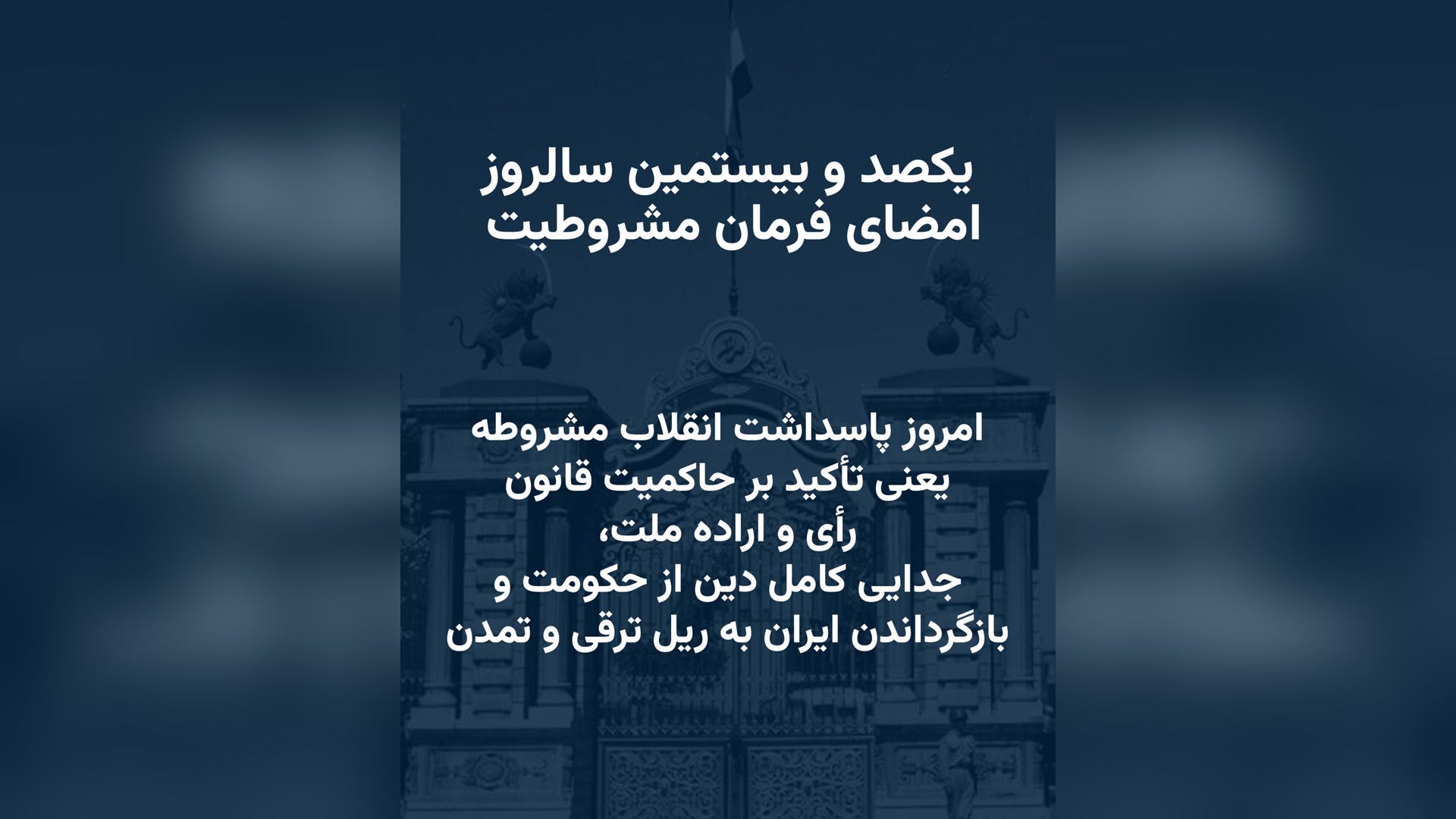
Today, to honor the Constitutional Revolution means to insist on the rule of law, the vote and will of the nation, the complete separation of religion from government, and the return of Iran to the track of progress and civilization.
On this basis, my program for guiding Iran through the transition period emphasizes the holding of free elections, the sovereignty of the nation's vote, the formation of a Constituent Assembly to determine the country's future course, and the creation of the conditions for prosperity and well-being for all Iranians.
May the anniversary of the issuance of the Constitutional Decree be honored, and may the memory of all those who strove for freedom, law, and the progress of Iran be eternal.